Monday, 18 March 2019

The Grand Vestibule

This is my first post for a couple of weeks. I have been writing up my research ready for submission at the end of the month[ish] and it has been slow going as I have got many questionnaires and notes from focus group meetings to comb through.

I have been using UE4 to design and VR get a feel for the space we are using for our upcoming graduate show in the Grand Vestibule in The Winter Gardens, Blackpool. I spent almost two hours measuring the space, but it only took an hour to piece it together in UE. However, as always, it took a lot longer to create realistic lighting and find usable textures...


Photo of The Grand Vestibule. It's got to be the best name out of many of the spaces I have worked in.


I have the option of adding doors, windows, plants etc., but the initial space gives me a fairly good idea how the exhibition will look in this space. The ceiling is definitely too high!

I will keep you updated... back to analysis etc.

If you are reading this blog and feel you can add something to my research then please comment… even if you are correcting me or don’t agree with something that I say.

Friday, 15 February 2019

Why include seats in a VR Gallery?

Below is a selection of VR galleries I have come across online... During my presentation the other day, I finished with the following question:

Why include seats in a VR Gallery?

It is not just seats, it's also decoration, furnishings, plants and lights! Galleries and museums have been around for a long time and they bring with them a powerful idea about what a gallery should look like and those pre-conceived ideas are deeply embedded... something to think about?


If you are reading this blog and feel you can add something to my research then please comment… even if you are correcting me or don’t agree with something that I say.

First Presentation

I was asked to give a short presentation about my project as part of a photography evening that also included talks by two photographic artists.


Libby Nightingale talking about her current project.

At the moment, this project has a number of different facets that surround the central question and I have explored each one a some detail. However, this means that I have gathered a lot of information, that now needs to be presented in a coherent and understandable way.

A couple of weeks ago I was asked to sum up the project to that point, which completely threw me and I was unable to string a coherent sentence together about it. So this presentation gave me the chance to do something about it as I know I have many more to come.

Preparing for it really helped to focus my mind and I was able to split the project down into the following areas: technology; test spaces; pre-visualisation; platform for new ideas; and I talked a little about case studies and my focus group. Most importantly, I was able to present some of my initial findings, which I have included here: (I feel I can say with some certainty that...)

  • It is a useful tool for curating and pre-visualising the size and scale of artworks.
  • It encourages students to think carefully about who their audience is.
  • It challenges preconceived ideas about what a gallery is.
  • It highlights the importance of gallery architecture.
  • It has given students involved in the project more confidence in their work.
  • It will give the college a foundation on which to base its implementation of VR resources in the creative arts.


The evening also allowed me to demonstrate and showcase my VR galleries and the ones I developed with students. I didn't realise I had produced so many and how diverse they were. Off the back of that, I have made some initial plans for a couple of possible collaborations; one as a way of presenting/showcasing an MA photography project and the other as an immersive art work.

If you are reading this blog and feel you can add something to my research then please comment… even if you are correcting me or don’t agree with something that I say.

Monday, 11 February 2019

Sketchfab - Instamuseum

Sketchfab - Instamuseum creates a VR gallery, for mobile phone viewers like Cardboard, out of your images on Instagram. This neat piece of software was launched in 2016, but this is the first time I have come across it (it's amazing how things can get lost in the internet).


There are some examples of the gallery here... https://mashable.com/video/sony-ces-mike-fasulo/

If you are reading this blog and feel you can add something to my research then please comment… even if you are correcting me or don’t agree with something that I say.

Thursday, 7 February 2019

Valuable Feedback from Focus Group


In a direct follow-on from my previous post, I met with my focus group (possibly for the final time) to review the galleries that the immersive group designed and to discuss the use of VR in creative arts education in the future.

Firstly, I would like to share the feedback and thoughts the focus group had about their fellow students VR galleries. I have typed up and listed their comments, under each question, in no particular order -

What did you think of Helen's, Nikki's and Carl's galleries?

  • I think they were very immersive and the themes they created went perfectly with their style of photograph.
  • Hellen use of light, whether or not intentional, created a definite route [to follow] on the floor. The vast airy white space reflects the theme of memory.
  • Exciting, talented, shows possibilities of where [art]work 'can go'. Love the textures, colour tones within Nikki's [gallery] and love the shadows and lighting strategically placed in Helens.
  • Nikki's is very claustrophobic but the bright and colour full ,photographs make it work. The textures add to the story. I like the theme.
  • Helen's intentional bright lines and shadows on the floor direct you, like line on a road... this is the order I want to see the work. A great sense of space.
  • The building itself, the alcoves work just like a frame.


What do these galleries offer that images alone do not?

  • Ability to explore different contexts. Explore scale and context in more detail.
  • Examples of how work can be displayed, show [the] scale of where [art]works can go.
  • Context and scale. Gives them a new dimension as opposed to viewing flat on screen or print. Scale lets you see details that you might miss on viewing alone.
  • A sense of reality about your own work being seen in a gallery. They feel real.


Do you look at the galleries differently, having been involved in the building process? (immersive group only)

  • Definitely - I've gone from being very wary of a gimmick (i'm not from a technological background) to see [it] as a tool to planning an exhibition. Great as a learner or curating. No longer just for gamers - now an element of the real world, init!
  • (Awaiting a further response).


Secondly, the questions go on to ask about how the college and learners might use the technology in the future.

How do you think we (the college, CADI) could incorporate VR technology into our teaching?

  • Give students the opportunity to curate and learn using their own images, ahead of the final [graduate] exhibition at level 6. At level 4-5, final images for modules could be used to build a gallery to see presentation before hand-in.
  • To showcase [art]work and encourage peoples confidence in themselves and their practice. Be a part of photoshop or as a one-to-one basis before hand-in... or along the way.
  • Mini sessions curating gallery set-ups. Selective lessons combined photoshop to incorporate people seeing their work within gallery environment.
  • Provide a facility two weeks before hand-in to view images in VR space. Use it to help plan an actual exhibition... it is positive - confidence giving, shows possibilities and helps to think about you [art]work in a wider context.


Is VR technology actually useful, or do you see it as a novelty/gimmick?

  • I feel younger generations may see it as a gimmick, but still want to be involved after seeing what it can do and I would find it really useful, curating Free Range (their graduate show in London) and showing me possibilities of the size I can print my [photography] work.
  • I think it is a useful tool to educate and encourage people. It gives an insight into the world after graduation and the quality of your images.
  • Very useful - see answer under immersive group [question].


Can you see yourself using it?

  • If it was accessible. I can't see myself buying it, but if it could be lent on an ad-hoc basis - yes.
  • yes to experiment with framing and the layout of the gallery.
  • Of corse. It's useful for many things linked to photography. - great if would like to pursue curator career, or great selling point to future photography post, very modern.


What is holding you back from using it, or what do you think will hold you back from using it in the future?

  • Cost and access.
  • Cost and I feel sick due to the motion [I think that was down to using the oculus Go].
  • The cost mainly and the quality is a bit low.
  • Cost. If it was readily available to me I'd use it every time as a means of checking my creative work.


What would you like to see in an application program - VR environment building software?

  • Infinite colour palette for floors/walls/ceilings.
  • Possibly artist statements when click within a piece of art, with person who's image it is voice, authenticity.
  • Is there anything else you would like to add?
  • When you really think about it, VR can ultimately level the playing field.
  • It's a great selling point. It updates the photographic medium.
  • It's very clever. Shows how photography has moved on and where we are digitally.
  • Good promotional tool for the course. Good selling point as heads in the direction of future business prospects.
  • [I am] Grateful for the chance to use such clever technology at a time when I'm ready to enter industry.


There are a couple of surprising points that came out of this meeting. The first is how much confidence it has given the students involved, in their own work and the second is how much they actually see it as a useful tool in curating and planning future exhibitions - and those responses came under the question about VR in education!

If you are reading this blog and feel you can add something to my research then please comment… even if you are correcting me or don’t agree with something that I say.

Wednesday, 6 February 2019

VR Gallery In Practice - Case Study

I asked three final year photography students to design a VR gallery for their own work. I wanted to put into practice, a possible way in which we may try and include this new technology in creative arts, degree level education.

I wanted to look at and test things such as; practicality (the process), preconceptions, perspectives, creativity and reflection... and whether it is actually beneficial.

To ease the process, I worked with Helen and Nikki, one-to-one. I tried to take their design and vision and turn it into a gallery that worked for them. At each stage of the design process, they were able to dip into VR and view what they had achieved at that point and make any changes they though necessary.

First up was Helen. She had a series of six images and she wanted to build a gallery that was large, light and airy with lots of natural light. She wanted her photographs to be big! She also wanted the images to be seen both individually and all together, with a central starting point. We made an initial sketch to get the process started.


Once in UE4 I created a starting space that was the same size as the room in which we were working, to try and help Helen visualise the size of the space she was creating on the computer.

As light and space were very important, Helen created a large and airy central space with lower alcoves off to the sides to contain and frame the large artworks. During the initial build process, we accidentally created a high and narrow 360 degree window. Helen immediately saw the potential and included it in the final design. She also included a couple of sky lights.


The windows let in a lot of natural sunlight and projected distinctive highlights across the walls and floors of the gallery. We had to move the sun around a bit so that it did not settle directly across any of the artworks.

Helen's initial thoughts on completing the gallery were very positive. She felt the space was light and airy... she really liked the light.. and that she could lie on the floor and watch the clouds go by.

About the process. Helen did have lots of preconceived ideas and did initially go for a white box. There would have been no windows had she not recognised the potential for them during the build, which is a fantastic argument in favour of practical practice/creativity, followed by reflection and development! Without windows, the side rooms would have felt claustrophobic and the space would not have felt so real.


Helen worked very intuitively until she created a space that 'felt right', a comfortable space for her photographs and the visitor.

One thing, that I felt was very interesting, was that she possibly would not have given the work its own space/room had she not seen Jeffrey Hammond's work presented in individual rooms in the VR version of his exhibition a few weeks before... so VR does have a lasting impact...


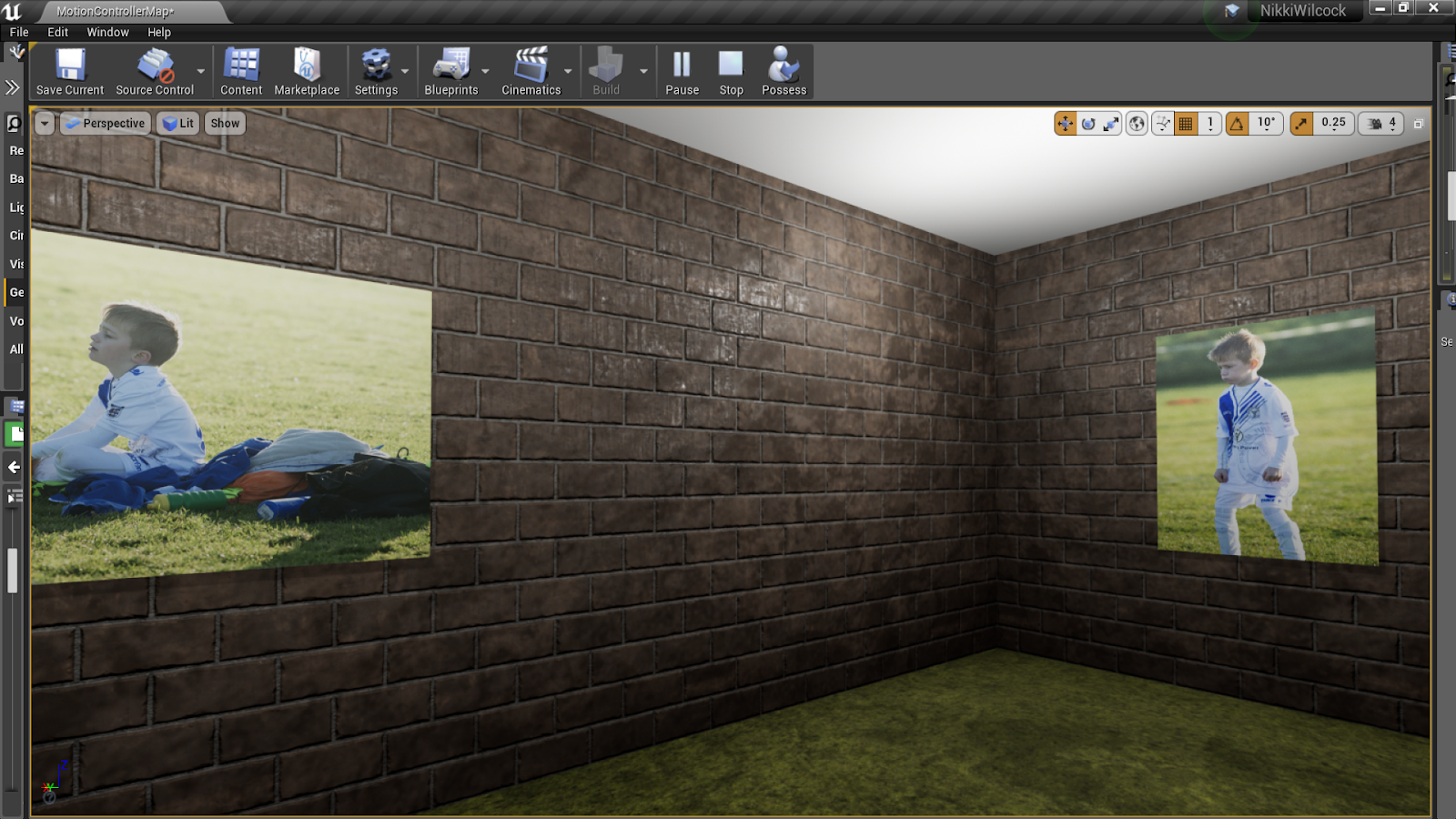
Nikki was next up. Her images were about grassroots football. She had initial hopes of immersing the viewer in football culture and I think she managed to achieve that.

She had a series of four images that she wanted to present in a very specific order and a rule that the last two images must not be visible whilst the viewer is looking at the first two. So the first designs were based on a dogleg. The design progressed and evolved to include a changing room, in which the viewer was to start their journey. Nikki said that 'you can feel and smell the building, sweaty socks, liniment, Winter Green Leg Balm'. Out into the corridor, one is met by the first photographs and a carpet made of grass, like stepping out onto the pitch.

As the build progressed, Nikki felt that it was portraying an authentic view of the subject - it successfully set the scene - to take you there. As you turned the corner, you are met by the final two pictures and a heavy white window frame with large window - the goal, that looked out over an endless expanse of grass.


On completion, she felt that the gallery (experience) gave her work a place. Reflected a backyard kick-about and grassroots football.

Seeing her work at larger sizes, she felt, gave the images meaning and importance - to the telling of that story.

About the process. Nikki admitted to starting conservatively, it took a little while to drop her preconceived ideas about what a gallery should and could be. She liked the organic building process and freedom of expression that it offered. Being able to drop in and out of the VR headset gave a firsthand experience [of what the viewer would see] that enabled her to change something within the design or assess her build during the session. Nikki took that proverbial 'step back' a number of times, to admire her work and it was clear that it was an important aspect of the design process for her.


Last up was Carl. He has some experience of 3D design software, Maya and UE, so he decided to create a gallery without my help. His gallery is massive, positively palatial and it took me a while to find his artworks!

The first thing that hit me is his use of natural light and the surrounding landscape that is very evident through the large widows opposite his photography.


Unfortunately, I was unable to view the space in VR as Carl have left out a couple of technical steps that would have allowed it. But, one does get a fairly good idea how the space will work in VR. One thing that I think he has missed out on, is the ability to view the progress of the build in VR, as it does seem to have affected Helen's and Nikki's design choices later in their builds. I will report back here once a VR compatible gallery has been produced.

In conclusion, we can see that the practicality of doing this is not problematic for such a small group of people, working one-to-one with me, but that would not be practical if there were more students (which there is).

The build and creative process was very positive and allowed Helen and Nikki to achieve original results, and the ability to live view in VR  allowed them to instantly reflect and develop the design in a fairly relaxed and organic way. Arguably the Ikono Space software would allow then to do this without me as it is very user friendly and not as complex as UE4.

They both designed spaces suited to the context of their work. But these contexts were hugely different. Nikki created a space that added to her story, whilst Helen created a space that supported her story - the idea of memory (which is what her work is about).

Their preconceptions, it seems, were the most difficult things to overcome and I think my being there went someway to helping them do that, as Carl's gallery is the most traditional looking of the three (and I didn't help him at all). However, I foresee that a period of development, undertaken over a few days rather than two hours would encourage students (with some guidance), to drop these preconceived ideas through experimentation and reflection.

Is it actually beneficial? yes. Both Helen and Nikki felt that the process of design and curation encouraged them to really think carefully about the context of their work and who their audience is.

What next? I will present the galleries to a wider focus group and try and get a better idea about how the student think we can embed this technology into the degree curriculum in a positive way.


If you are reading this blog and feel you can add something to my research then please comment… even if you are correcting me or don’t agree with something that I say.

Tuesday, 29 January 2019

UNIVERSITY OF SALFORD ART COLLECTION ‘WHAT’S IN STORE’ VR GALLERY

Salford University's collaboration with ArtSeeCare, a company which seeks to bring art to people in hospitals through VR.

http://www.metaobjects.org/work/university-of-salford-art-collection-vr-gallery/


If you are reading this blog and feel you can add something to my research then please comment… even if you are correcting me or don’t agree with something that I say.

Virtual Reality In Education: A couple of useful links

General links to articles and websites about VR in education...

This is a blog post by Kelly Singh who talks about VR in education and its potential benefits:
https://briovr.com/blog/virtual-reality-in-education-a-teachers-guide/

Amber Osborne is the CMO at Doghead Simulations, a virtual reality meeting software company. This is an article where she discusses their virtual class room in which she references Ready Player One:
http://missdestructo.com/2018/01/virtual-reality-in-education-making-ready-player-one-a-reality-with-rumii/


A Daily Telegraph article:
https://www.telegraph.co.uk/education/2017/01/23/school-using-virtual-reality-prepare-pupils-future-dominated/

The possibility report: With VR the World is Your Classroom:
https://www.theatlantic.com/sponsored/vmware-2017/vr-world-classroom/1658/

...and there are a lot of companies popping up, who are providing/supporting VR in education (in no particular order):

http://www.primevr.co.uk/

https://immerse.io/?gclid=Cj0KCQiAkMDiBRDNARIsACKP1FH86v2EGG_VlrKqOGGDOFcVc3Hq4hQY_EBlnMsrfBp4F0HCLRml5b0aAhnlEALw_wcB

https://www.yourcloudworks.com/education/google-for-education-buckinghamshire/virtual-reality/?gclid=Cj0KCQiAkMDiBRDNARIsACKP1FE-8Dub7J2zNhUFyvMYQpXwrhR66eG4MAmgd064qg327vj5DrQO6nQaAsICEALw_wcB#.XFBBs5PFKV4

http://www.classvr.com/virtual-reality-in-education/

If you are reading this blog and feel you can add something to my research then please comment… even if you are correcting me or don’t agree with something that I say.

Sunday, 27 January 2019

A Gallery for Fine Art Student's Digital Works

This was meant to be a post about the inclusion of moving image in VR galleries, in this case GIF animations. However, it turns out that GIFs are incompatible with UE4. It looks like I have to create a grid out of the individual frames and import as a flick-book. I will see how I get on tomorrow.

In the mean time... I have created a space that includes a number of elements that worked well on previous builds - lots of daylight, differentiated ceiling heights, one room/wall per artwork, directed movement and spot lights.

But, does that mean I have created a better gallery? In this case I don't think it does. I don't get the same 'buzz' as in previous builds. The important thing for me, is that this technology allows me to test, analyse and reflect and then try something different. I seem to learn something new with every build. Fantastic!


Plan of gallery, ASCII style -
_____________________
I   I   I   I   I   I   I   I   I   I
I----------------------------I
- That's how this project would have looked if I had used a type writer! Thankfully, things have moved on :)

If you are reading this blog and feel you can add something to my research then please comment… even if you are correcting me or don’t agree with something that I say.

Friday, 25 January 2019

Towards A New Museum

Towards A New Museum, is another book by Victoria Newhouse that is relevant to this project.


The book is a compendium of gallery architecture that has become so dominant over the last 40 years. It discusses galleries as diverse as the Guggennhein Museum in Bilbao, to galleries as yet unbuilt by Frank Stella (and also includes Peter Blake's ideal museum for Jackson Pollock that I have mentioned in a previous post).


The book is well illustrated and the descriptions offer insight into the architects vision and references easily missed by the casual viewer. For example, the gallery built to house the paintings of Felix Nussbaum (p. 96), was designed to reflect the spaces in which Nussbaum worked whilst he was in hiding from the germans before he was tracked down in 1944. The architectural features are based on axises tracking through local features and Auschwitz. Newhouse is partially critical of the museum and questions 'whether this particular [gallery] fulfils its function as an exhibition space as effectively as it calls forth the horror of persecution' (Newhouse, 2006).


I read somewhere that architecture was considered the highest form of art and when exposed to forward thinking and diverse galleries, as represented in this book, it is hard truth to deny.

For the purpose of this project, it offers a fresh view of gallery design and help to dispel those preconceived ideas that I am finding so hard to encourage people to do. The book discusses over 70 galleries and most of the reviews are well illustrated and include floor plans... just flicking through the pages offers up so many ideas for gallery design that push the boundaries, that are so easy to recreate or develop in VR, that will hopefully encourage boundary pushing in this new technology.

Newhouse, V.(2006). Towards a New Museum. Monacelli Press, New York. (ISBN-10: 1580931804, ISBN-13: 978-1580931809)

If you are reading this blog and feel you can add something to my research then please comment… even if you are correcting me or don’t agree with something that I say.

Thursday, 17 January 2019

The Artist's Studio

I had a conversation with an artist yesterday, about the importance of the studio space. He had worked in a number of studios during his career and reckoned that each change in studio coincided with a change in his artworks. He said that he has worked in some exceptionally inspiring spaces and some very uninspiring ones. It is clear that the studio space is very important to an artist.

Links to videos and articles about artist studios...

Frances Bacon

Piet Mondrian


https://www.francis-bacon.com/artworks/studio

https://www.gautierdeblonde.com/?portfolio-item=portfolio1

https://www.theguardian.com/theobserver/2000/sep/10/features.review17

I wander how a VR space, given that it could be a 'virtual' extension of an artists studio, would affect their work. Would they, like Mondrian, design and utilise a space that directly reflects the style of work they produce, or like Lucian Freud, choose earthy and neutral colours and a space that does not become more important than the work (I have mentioned that sentiment in a previous blog post...as a rule?).

The Speed of Change

An observation (not worth its own blog, so I have included it here). I have got in to the habit of Googling 'VR Gallery' or VR Art Gallery' on a weekly basis and the rate of development is quite astonishing. A new gallery pops up daily.

However, I think the VR gallery has yet to find its legs as (still) most of the galleries out there are recreations of existing galleries. It seems to be taking longer than I initially thought for designers to drop their preconceived ideas about what a gallery is, and start to design spaces unique to VR. Affordable VR has been around for about three years now.

I am trying to move away from the traditional and explore new ground, but those historic and emblematic features [of a gallery] are deep seated, and even with this knowledge, I am finding it hard to design and make my attempts at new ground stick (or at least work).

If you are reading this blog and feel you can add something to my research then please comment… even if you are correcting me or don’t agree with something that I say.

Monday, 14 January 2019

An Island Gallery


Following a conversation with a final year photography student, Helen Kay about light and airy gallery spaces in which to exhibit her photographs and a passing comment about floating a gallery on water, I decided to build an outward facing island based space that is lit mostly by 'natural' daylight. I started with a single building...


...and I was happy with the initial result. However, I felt it needed expanding, to include an opposite space, so I created another island gallery...


I used the same artworks, so I could make a direct comparison between the effect both spaces has on the viewer and artwork.


The most interesting thing is, by reversing the gallery so it is outward facing, means that each piece of work has its own space! and because the viewer is looking in, means that the outside does not interrupt the interaction. The nice thing about this setup, is that one can look at the work in isolation, but not feel confined. I am not sure that one would have come to the same conclusion without being able to view it in VR (although I did think that would be the conclusion beforehand, but it is nice to have it confirmed in VR).

I am also starting to experiment with colour and in this case, I wanted to recreate the water and some of the airy tones in the artworks.

The artworks are by Helen Kay and you can view more of her work on her website: https://www.hellykayphotography.co.uk/ and Instagram: @helenkayphotography is a participant in my research and I will be reviewing a gallery that she designed and built for her work, which in part, influenced this build.

If you are reading this blog and feel you can add something to my research then please comment… even if you are correcting me or don’t agree with something that I say.

Friday, 11 January 2019

Rosie Flo's Colouring Art Gallery


For Christmas I was given Rosie Flo's Colouring Art Gallery as a present. It is a self assembled cardboard gallery. A bit of fun. However, it did get me thinking about how we plan for exhibitions, past and present and how VR relates to it.


I have used models of a gallery in the past to plan, in a fairly detailed way, how artworks will be displayed. These days, I have a much less formal approach. I will have a good idea where one or two key pieces will be sited, but I like the flexibility of being able to leave it until the beginning of the installation to work out where the rest of the works should go. Maybe VR will enable me to plan, in a more concrete way, in advance of an exhibition... it would certainly save time during installation as most of the time is spent placing the work

To come to some sort of conclusive ideas on the subject, I thought I would do a quick comparative analysis between the/a cardboard model of a gallery and a VR gallery as a planning tool. I will look at scale (as in the accurate size of the things rather than a comparison of scale), art placement and position, proportion, usability and pre-visualisation.

A cardboard model can provide a good sense of architectural scale if the gallery measurements are down-scaled accurately (i.e. 2cm = 1m and 1cm = 50cm). All the walls need to be cut to size and the images scaled down (accurately!), printed (assuming they have been photographed first) and cut out. These can be time consuming tasks, especially if the gallery has many hanging surfaces and there are lots of artworks. It can also become quite fiddly if there are a lot of small works that would potentially be printed at a tiny size. However, this is all pointless if there is nothing to illustrate the scale in real life, so one has to include scale models of people as something to relate to.


A VR gallery can also provide a good sense of architectural scale as long as the original gallery measurements are accurate. In UE4, one can convert sizes directly (i.e. 1point = 1m and 0.01 = 1cm) which is quicker than having to use a calculator for every wall, floor and doorway. Assuming that the artworks have been photographed, all images can be easily imported and sized just as simply. There is no cutting out, but there is some calculations involved in working out the height and width ratios so the artwork does not look squashed or stretched, but it is undoubtedly quicker than the model. A VR gallery does not need life sized models of people to illustrate scale because the VR experience happens at normal scale. The Oculus user is well able to perceive scale as they move through the gallery.

Both the model and VR allow one to workout art placement and spacing equally well (as long as everything is scaled accurately). A cardboard model can be fiddly, if the original artworks are small and one is never going to position works accurately and level, but it does do the job. However, VR is going to have the advantage of allowing the curator to walk through a potential set-up. If one was to try both approaches to work out the size and proportion of an artwork, then the model is going to be much more time consuming as multiple prints will be needed to be produced and cut out. It is very simple to resize images in UE4. Again, VR is going to be more useful as the impact on the viewer can by directly perceived.

Up to the point of being able to walk through a potential layout, both approaches are usable, but VR is going to make life a lot easier, because everything, from resizing to moving placements can be very simply achieved in UE4 and the effects easily measured with the Oculus headset. The plus for a cardboard model, is that almost anyone can cut and tape a representation of a gallery together. Not everyone will have the inclination or time to learn to use a 3D design programme (UE4 in my case) to create a model of a gallery!

A cardboard model does a fairly good job for pre-visualising an exhibition, especially if it is photographed from the scaled position of a visitor, but one is unable to experience the impact of the overall exhibition (on the eventual visitor) in the direct way that VR does so well.

At the end of the day, I will never completely rely on a pre-visualised model to plan an exhibition, as I like the freedom to change things around before installing (if need be). Having said that, I know my gallery well, but pre-visualisation could be a great tool for planning exhibitions in spaces I have not used before (but I will still hang on to flexibility on installation day).

If you are reading this blog and feel you can add something to my research then please comment… even if you are correcting me or don’t agree with something that I say.