Friday, 7 May 2021

Minecraft Art Gallery

One of my students, James Hanks has created a virtual gallery for his photography work in Minecraft. He talks about the gallery in this video -


There are a couple of things I like about this project. James's exploration of scale and alternative viewing points, above and below is really interesting as he is clearly questioning tradition. He also experiments with different viewing experiences between a 'traditional gallery' and an external exhibition. Again, questioning the norm. He offers partial control of the experience to the visitor, by giving them a choice between artificial and natural light (sim notwithstanding). The final thing, that I really like, is how an unexpected change in the weather completely changed the experience and context of the artworks!

I would be interested to see how James manages to market this exhibition and idea (he talks briefly about it in the video).

If you are reading this blog and feel you can add something to my research then please comment… even if you are correcting me or don’t agree with something that I say.

Friday, 30 April 2021

Freya Fine Art - VR gallery

I really like the interactive nature of Freya Fine Art's VR gallery. It is a web-based (webXR?) virtual gallery. I like the way you can move smoothly around the space and how it allows 3D works and installations to 'do their thing'. You can tell that the designer has thought carefully about the experience; it is well laid out, nicely lit and a pleasure to use (and they have not included seats!). This is the kind of interaction I am looking to step up to, as well as the ability to scan and include sculptural pieces. You can view this great gallery here - https://freyafineart.com/ - I have yet to view it through my Quest 2 and I don't know what the load speeds would be like on slower data speeds. 


If you are reading this blog and feel you can add something to my research then please comment… even if you are correcting me or don’t agree with something that I say.

Wednesday, 21 April 2021

Virtual Art Galleries: What happens now?


My thoughts have recently focused on what happens now we (in the UK) appear to be coming out of lock-down and covid protection measures. Is there a future for VR/virtual galleries? and what will they look like?

A positive thing to come out of the crisis was the sudden need for alternatives to 'normal' art galleries... which was great for me as it allowed me to use my skills to help provide it (and improve them on the way).

On the whole, it seems that many people have been forced into confronting technology that they might otherwise have not done so and I have seen the benefits of it. For example, two of my most popular galleries have seen 9000 and 4000 visits, far more than we could have hoped for in a normal onsite exhibition.

It does look like virtual galleries will continue to run alongside real exhibitions. Commercial galleries have seen the benefit in terms of online visitors as well as the indefinite length of low-cost exhibition time. This could either be in a completely manufactured space or even a 360 photographic tour (which would be a lot easier to produce on the back of a real exhibition). Indeed, a number of commercial enterprises have been set up in response to gallery needs during the lockdowns, which will create a virtual gallery to order.  https://emperia.co.uk/art/ and https://exhibbit.com/home/ are examples of this. Public galleries have also introduced virtual exhibitions like these two from The Harris Museum in Preston - https://www.theharris.org.uk/product/the-artful-line-2/ and Open Eye in Liverpool - https://openeye.org.uk/whatson/vr-l-a-city-through-its-people/

On the back of these commercial needs and enterprises, there appears to be more potential for curated online content rather than individual artists web sites. I have noticed that a number of 'normal' gallery websites have started to curate online exhibitions, made up of work by many different artists. These are not necessarily virtual shows; they could just be a collection of images on a page. Normally, art websites are based around the individual (artist), but the lockdown has seen a rise in mixed content, in its own right, and is not something we have seen outside of supporting info for normal curated exhibitions and competition pages. This could potentially feed into a continuation and need for virtual galleries.

We may now see individual artists make use of this technology to self-promote their work. Lock-down has shown people that they do not need to rely on traditional systems to exhibit. Accessible technology has democratised the process, similar to what YouTube has done for grassroots music and film. For example, https://www.artsteps.com/ provides an easy-to-use platform and interface for users to create their own (free!) virtual exhibitions and there of hundreds of self-made galleries to explore.

It appears that lockdown made viewing artworks, in an experiential way, online more acceptable, or at least has shown people that it has worth. Perhaps that will continue into the future where other areas of legacy have yet to reveal themselves.

If you are reading this blog and feel you can add something to my research then please comment… even if you are correcting me or don’t agree with something that I say.

Thursday, 1 April 2021

Cassetta.co.uk

 I felt that it was time that I created a formal portfolio of my VR and virtual gallery projects... so here it is - www.cassetta.co.uk (I thought that cassetta frame was too long).


Let me know what you think.

If you are reading this blog and feel you can add something to my research then please comment… even if you are correcting me or don’t agree with something that I say.

Friday, 19 March 2021

All That Glitters


All That Glitters is the first project I have designed and exhibited that features work from a single artist.

In response to the photography by Richard Weston, I wanted to create something grand in scale and colourful. I also wanted the exhibition to feel like a journey of exploration and discovery.

I used colour from the LBGT+ flag throughout the space but used more muted colours, tones and textures to add neutrality and breathing space in which to view the works. I used wooden slats to create space (a caesura) above the ceilings and texture to combine elements of the larger space.

The things that have worked really well are the glowing LBGT colours at the back of the gallery and the reflection of them on the dark floor. The slats have softened the ceiling and created the idea of space beyond... intimate immensity. The large room positions the main stars of the show opposite each other and the grounding of the smaller works (on the concrete panels) help to reinforce a sense of scale. I think the scale works well in this case... even with the distortion that comes with viewing oversized images in this format.

The things that have not worked so well; are some of the textures do not look real enough, either from being to mottled or contrasty (the concrete panels) in their texture or rendering a little on the soft side (in the corridor). I think the neon signs could have more glow/bloom, then they would look great. I may make some changes to the initial exhibition space as it does not feel 'right'. I think some differentiation in the size of the two photographs on the left will help.

I am really looking forward to my next project. I hope to work with another artist and single body of work. And once again, my design will be created specifically for it. It looks like it will encompass nature-based textures and colours.

Please take a look at the exhibition...

Many thanks to Richard Weston for allowing me to work with his project. He is a Manchester-based photographer. Check out his website - http://westondigitalimaging.co.uk/

If you are reading this blog and feel you can add something to my research then please comment… even if you are correcting me or don’t agree with something that I say.

Wednesday, 3 March 2021

The Virtual Gazette Young Seasiders Schools Art Exhibition

My latest project has been a big one. The gallery design is based on the gallery in Blackpool School of Arts and apart from time spent creating natural lighting, was the easy bit. The biggest part of this project was creating the content... 38 schools, each with at least 10 pieces of work. It only took two days, but I was starting to go crosseyed!

The exhibition was designed to look similar to the normal annual Young Seasiders exhibition. I have included a photographic tour, that I shot and pieced together last year, at the bottom of the page.


Virtual Blackpool Young Seasiders Exhibition hosted on Kuula.co.

Photo tour created for last years exhibition.

If you are reading this blog and feel you can add something to my research then please comment… even if you are correcting me or don’t agree with something that I say.

Friday, 12 February 2021

Wish You Were Here


I have had a busy couple of weeks creating a new VR/virtual exhibition for the final year photography students. We felt it would be good to get in early before all the other grad shows appear in May/June, but with plans to update the work in a couple of months.

I am really happy with how this space has turned out. It is compact, it is interesting, and I am really proud of my lighting skills and use of different textures in this space. It is actually a loose interpretation of Bauhaus' square, triangle and circle aesthetics.

The exhibition is called Wish You Were Here and you can access it here, even though it has not been officially launched yet.

Edit: I've embedded it below...


Monday, 25 January 2021

Back on it, with a big leap forward.

 This years VR projects are rolling in and now semester one is over, I have the time to complete them.

I start with a big breakthrough. Accurate reflections!


The next big project is a virtual version of the 75th Blackpool Seasiders exhibition. And it is big. 50 schools, all exhibiting at least 10 artworks each. The image above is of my starting space, based on the college gallery. I have used it before, but every time I use it I update it... this time, as well as the shiny floor, it includes better hanging lamps, better textures and updated paint scheme.

The VR bit is the easy part. Most of the hard work will be completed it Photoshop. I am replicating the real exhibition poster/panel layout, so all the work from each school will be put into the same image file. I have included a 360 tour I took of last years exhibition to illustrate what it usually looks like and it is going to look similar[ish] in VR...


Tuesday, 5 January 2021

Vision 2020: Graduate Exhibition - The Whole School of Arts!

 I was tasked with creating a whole school virtual exhibition... for over 150 students! both FE and HE. I used the gallery I created for the BA Photography students and used it as a base for the degree students and created a completely new space for FE. You can view the gallery here


EDIT (5 Jan) I created a fly-through video for social media, but forgot to add it to this blog... it's a bit jumpy but works fine on Instagram etc.

I tracked most of this build on Instagram, so please have a look at my account and follow me... @cassetta.frame

If you are reading this blog and feel you can add something to my research then please comment… even if you are correcting me or don’t agree with something that I say.

Wednesday, 17 June 2020

VR Gallery Explosion (graduate exhibitions)

The covid-19 lockdown has seen an explosion of VR art galleries. There are now too many to keep track of. I have picked out a number of University graduate exhibitions for comparison to my own (later).

University of West London


Wow, what a riot of images and information. I am not sure what else to say... rock and roll! I am not sure what they were trying to achieve, but it is very hard to browse or concentrate on anything. To be fair though, it is for an advertising and PR, so probably not designed by a creative person. It was created in Artsteps.com online app.

North East Scotland College


Better than West London and made in the same artsteps software. Nicely designed and they have made a better use of scale for impact, but it is still very crowded. This small college from Scotland easily beats most University VR exhibitions. A very minor point - the walls are a bit thin.

Brunel University London


They have taken social interaction as the starting point for their VR exhibition. You are given an avatar and you explore the gallery amongst other avatars... the idea being that you can interact and chat with them. Great for the private view. However, I spent most of my time hiding from the other avatars as I was petrified they were going to speak to me! One downside is access to it. you have to click about six or seven links before you can get into it.

Liverpool School of Art and Design, LJMU


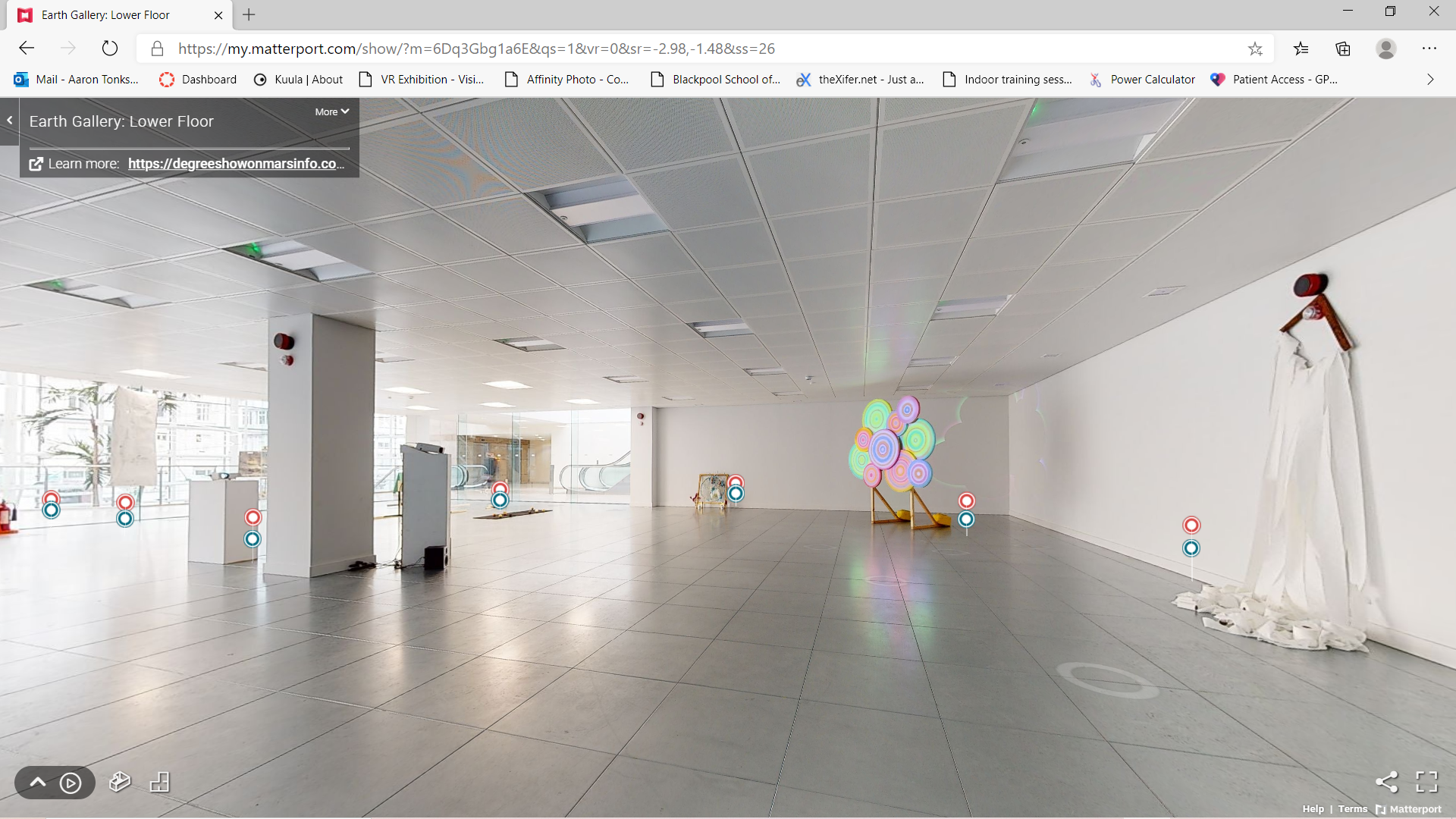
I like the ambition of this 'experience', but it is very glitchy and takes up to five minutes to get through to any work... It starts with an animated landing on Mars, after which, icons representing different students appear in the sky. You are meant to navigate through and click on the icons to view the artworks, which it does through a 360 degree photographic tour of the installations in a shopping centre, utilising Matterport (similar to Kuula.co). Mad, but maddening! They should have chosen Matterport and not bothered with the animation and 3D stuff.

Northumbria University


I like this exhibition. It is a tongue-in-cheek 2D version of everything we have seen above. It makes you question why we feel the need to create a very complex virtual exhibition as they have managed to create an easy to navigate and fun showcase utilising what looks like the plans for their now-cancelled grad show.

I have a couple issues with what I have seen. The big one for me is, why has all the work been installed so close together? Virtual space is infinite and scaleable, so there is no excuse. Just think how much more sophisticated North East Scotland College's exhibition would be if they gave everyone just a little bit more space. Also, you don't need portraits of the artists next to their work. The only people who are going to appreciate that are their parents.

The second big issue is download speed. The network speeds in your area may be very different from mine, so one has to design with the lowest common denominator in mind, LJMU. Also, navigation and ease of use can really impede the viewing experience. Every click of the mouse is the equivalent of a set of doors or flight of stairs in a real gallery and if you've gone through four doors and climbed three flights of stairs, then the work better be worth the effort. The experience must not overshadow the artworks!

Finally, an observation of traditional websites. The web page based grad showcases are way too daunting to attempt to navigate. They are either based around a great long list of student names or pages full of competing artworks. They may be cleverly and beautifully designed, but they can be very overwhelming. A final point here is how much better a nicely built 3D virtual gallery allows you to browse and navigate diverse (quality and theme) artworks... certainly compared with some of the webpages I have seen.

For comparison. This is a screenshot of Tubes 3D gallery, a commercial magazine based space. The artworks are shown at original size.

If you are reading this blog and feel you can add something to my research then please comment… even if you are correcting me or don’t agree with something that I say.

Friday, 29 May 2020

Virtual Exhibition

Working with digital imaging professional Richard Weston, we produced a virtual graduate exhibition for Blackpool School of Arts photography students...


I created the gallery space in UE4 and Richard used Tour Weaver software to create an interactive tour. You will notice that I have used the same gallery that I have been recently developing, but I have introduced side rooms designed to work best with 360 low res rendering in UE4.

I like the way that Tour Weaver straightens and zooms through to the next viewing point. It works a lot better than Kuula. However, it does not give you the option to view in mobile VR via Google Cardboard, which is a bit of a miss as VR stuff is hot at the moment. I am not a great fan of the labels and is something I need to think about moving forwards... maybe I should add them in UE4.

The gallery does give one a sense of how a particular piece of artwork would work in an exhibition space at a given size, so it works on that level, but it's never going to as good as full VR.

If you are reading this blog and feel you can add something to my research then please comment… even if you are correcting me or don’t agree with something that I say.

Sunday, 10 May 2020

Designing to application constraints

I have just finished creating a virtual gallery for a lock-down Instagram project called 21 Day 21 Photos. I say 'virtual' as it is not true VR. The most important thing about this gallery was that it was accessible the maximum amount of people possible via the internet. Not everyone has a VR headset, so it was important to build it on a platform that could be viewed via a computer screen or mobile device. This was the first constraint.

The second constraint surrounded the 360 export resolution on UE4... I should say that other game/3D design software may well export at a higher resolution (UE4 exports at 4096 x 20480, but I have not the time to learn them. This meant that the images could not be too small or too far away from the camera, or they would look pixelated and soft when the viewer zoomed in to get a better view. So I designed a fairly small gallery based on octagonal rooms so that all the photographs faced the centre and camera.


I built the gallery in UE4 and used an online 360 photo and tour application - kuula.co - to host it. It was really easy to use, and the pro version allows you to add hotspots that allow you to teleport around the space. It also allows you to add info buttons which means I could show high res versions of the images in a pop-up.

You can view the gallery here - https://kuula.co/share/7XDYb/collection/7lnPs


Overall, it has worked quite well. I have created an effective gallery that can be viewed on a computer screen, mobile phone or tablet and via VR headset. You can also view it in faux VR via Google Cardboard. It is not cutting edge, but it impresses all who have seen it and does the job it is meant to do.

If you are reading this blog and feel you can add something to my research then please comment… even if you are correcting me or don’t agree with something that I say.

Wednesday, 8 April 2020

Opportunity

The current covid-19 crisis could be an opportunity for VR to present a very real alternative to physical galleries and exhibitions.

I have just started to plan and design some sort of 'end-of-year' show for Blackpool School of Arts students, as a way of celebrating what they have achieved during these times of remote learning. So the exhibition needs exhibit up to 200 peoples artworks!

However there are some big hurdles to overcome. The most obvious being that only a very few people have access to a usable VR headset. So, at this point, it looks like there will be a combined approach between a VR and screen/web based platform.

At this point (I keep saying this, but things may change dramatically), I am looking to design amazing exhibition spaces in UE4 (for VR), but also capture 360 degree renders for use in an immersive (as much as it can be) web/screen experience.

To do this, I have been looking at Tourweaver (https://www.easypano.com/virtual-tour-software.html). Richard Weston (http://westondigitalimaging.co.uk/), a digital photographer based in Manchester, very kindly offered to generate a test site using 360 renders from my previous projects. And the initial results are quite promising...


(http://vision2020bsoa.co.uk/vr-exhibition/)

The main drawback is that the render resolution in UE4 is a little low, therefore the photographs in Tourweaver look a bit soft. However, the images can be re-edited in later using Affinity or Photoshop.

Some more research and discussions with Blackpool School of Arts are to follow and should result in a clearer idea as to the end point for this project. In the meantime here is a screen shot of my exhibition 'complex' in-progress.


If you are reading this blog and feel you can add something to my research then please comment… even if you are correcting me or don’t agree with something that I say.